
What Legal Education Makes Possible Inside Prisons
Gilbert and Jimmy began their legal studies in prison. One incarcerated, one a prison officer.
Both are now on the path to qualifying as lawyers.
Justice Defenders delivers legal education inside prisons in partnership with the University of London. People in prison and prison officers study law together to an internationally recognised standard, combining academic study with legal practice rooted in the daily realities of the justice system.
For those who demonstrate the ability and commitment to practise law, Justice Defenders supports their progression beyond the LLB through our Advocates Programme. This pathway, first forged by William Okumu and Hamisi Mzari, supports candidates through professional training, Bar examinations, pupillage, and entry into legal practice.
Two of the most recent candidates to progress along this pathway are Jimmy Mtawa and Gilbert Wanami. In January 2026, both received nine passes in the Bar examinations at the Kenya School of Law and are now on course to be called to the Bar later this year.
Jimmy is the first prison officer in our programme to reach this milestone. Gilbert, who studied law while incarcerated, now serves as a Legal Officer with Justice Defenders. Their journeys reflect different starting points, but the same professional standard.
What follows are their stories, in their own words: accounts of study, discipline, and legal practice under constraint.
Jimmy Mtawa
From prison officer to advocate.
I began my LLB while serving as a prison officer at Kamiti Maximum Security Prison. It is not an environment designed for study. The work is demanding, the days are long, and the pressures are constant. I am grateful to Justice Defenders for opening the door to legal education for prison officers and people in prison alike. That decision changed the course of my life.
Balancing full-time work with legal studies was difficult. Alongside my duties as an officer, I was involved in paralegal work, supporting incarcerated people with their cases. We studied together as officers and incarcerated people, sharing classrooms, discussions, and preparation. That experience reshaped how we related to one another. The law became a shared professional discipline, not a dividing line.
Midway through my studies, I was transferred to Kwale Prison, more than 400 kilometres from Kamiti, which remained my examination centre. Kwale had no lecturers and no academic support. I relied on self-discipline, long periods of independent study, and travel back to Kamiti for examinations. The physical and mental strain was significant. Giving up was not an option.
I completed the programme and graduated with a Second Class Honours (Upper Division). I then progressed to the Kenya School of Law for their Advocate Training Programme. It was rigorous and demanding. In the Council of Legal Education examinations, I passed all units and achieved nine passes (the 9 Ps).

Jimmy Mtawa receives his University of London law degree from Patricia McKellar, Undergraduate Dean of Law at the University of London.
Gilbert Wanami
From incarceration to admission to the Bar.
Before my incarceration in 2009, I served as a senior police officer. I enforced the law. Prison placed me on the other side of it. For many, that would have ended any professional ambition. For me, it became the beginning of a different kind of purpose.
In 2019, while incarcerated, I enrolled in the University of London LLB through Justice Defenders. Studying law in prison demanded discipline under constraint. Resources were limited. Time was restricted. Institutional barriers were constant. I immersed myself in statutes, cases, and legal reasoning. The prison walls confined my body, but not my resolve.
I completed the LLB in 2022. Inspired by colleagues who had gone before me, including Hamisi Mzari and William Okumu, I enrolled in the Advocate Training Programme at the Kenya School of Law. At the same time, I worked as a legal officer across Kamiti, Lang’ata, and Kiambu prison legal offices. I supported people who were often illiterate, poor, and navigating the justice system alone. The workload was heavy. The emotional toll was real. The academic pressure did not relent.
In November 2025, I sat for the Bar examinations. I passed all nine units of the Council of Legal Education assessments.
I am now beginning my six-month pupillage. After that, I will be admitted as an Advocate of the High Court of Kenya. This is not about status. It is about service. I intend to practise law in solidarity with people whose access to justice is most fragile.
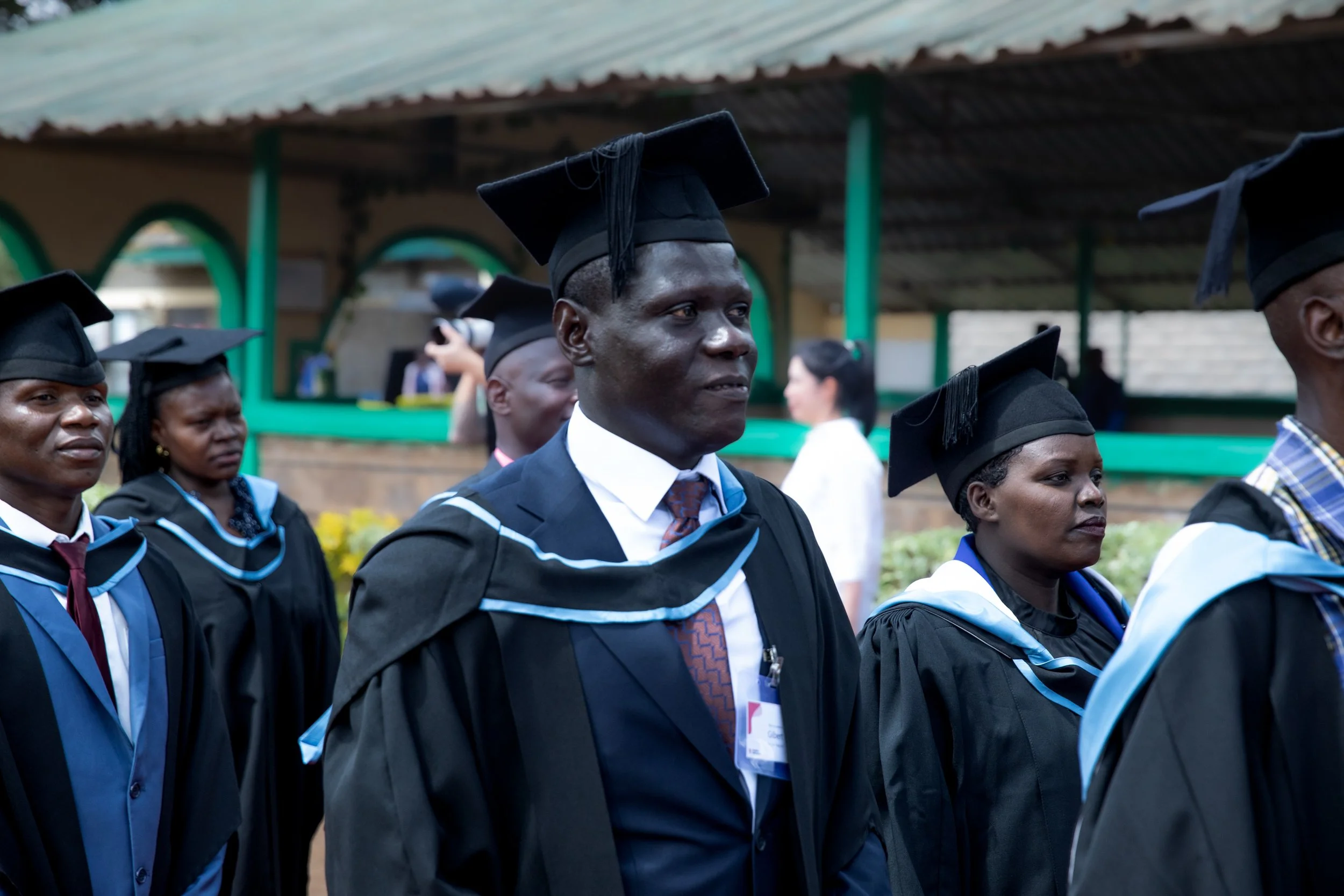
Gilbert Wanami during his academic procession at his graduation ceremony in Kamiti Prison, 2024.
We are equipping the next generation of legal defenders from communities that have known injustice firsthand. They are reshaping how the law is accessed and practised, bringing rigour, fairness, and lived understanding to the justice system.
You have a role to play in shaping this future. Your support helps turn legal education into legal practice, and lived experience into lasting change.
Fuel the defence. Donate today.